What to Look for in an LKG School in RT Nagar
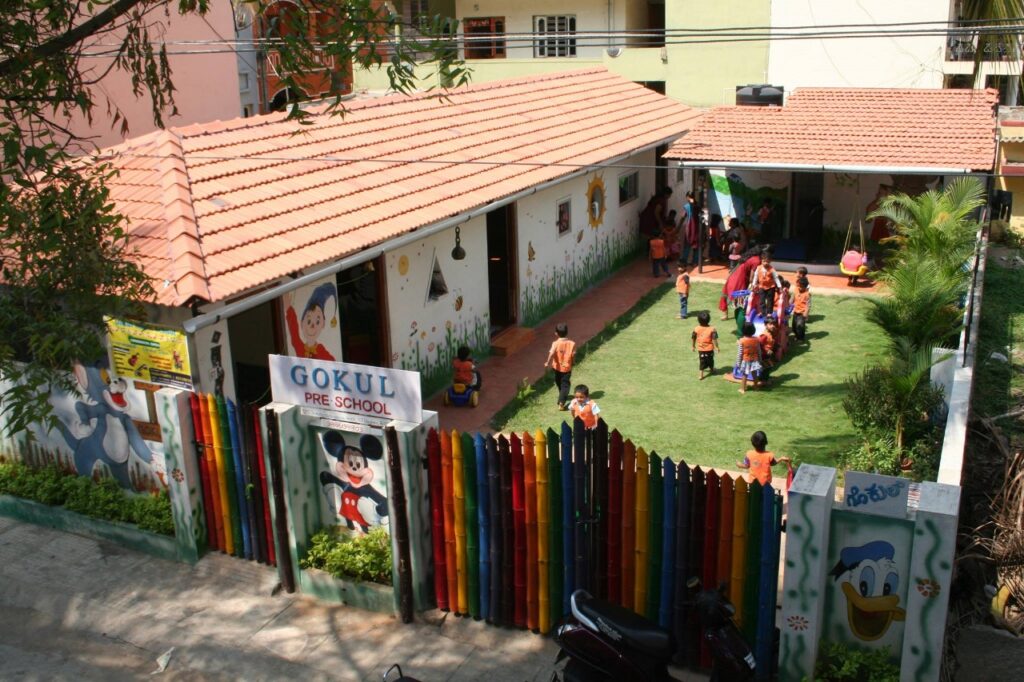
Choosing an LKG school in RT Nagar is an important decision for parents. Lower Kindergarten is often one of the first stages where children experience a more structured learning environment. At this age, children are learning much more than letters and numbers. They are developing communication skills, confidence, independence, social habits, creativity, and the ability to learn with others, Gokul Preschool.
With many schools and preschools available in and around RT Nagar, parents may find it difficult to decide which one is right for their child. Current school directories show that parents have a wide range of LKG options in RT Nagar, with differences in curriculum, school type, fees, class size, and facilities.
So, how do you choose?
Instead of looking only at fees, advertisements, or how attractive the school building looks, try to understand what your child will actually experience every day.
This guide explains the most important things to look for when choosing an LKG school in RT Nagar, Bengaluru.
Why Is LKG an Important Stage for Children?
LKG is generally a time when children begin moving from mostly informal preschool experiences toward a more structured learning routine.
But that does not mean children should spend the entire day sitting at desks.
Young children learn through:
- Playing
- Talking
- Exploring
- Moving
- Drawing
- Singing
- Listening to stories
- Asking questions
- Making things
- Interacting with other children
A good LKG programme should bring these experiences together.
The goal is not simply to make children complete more worksheets. It is to help them become comfortable learners who are curious, confident, and ready for the next stage.
1. Look for a Child-Friendly Learning Approach
One of the first questions parents should ask is:
“How does this school teach LKG children?”
Look for a learning approach that is suitable for young children.
An effective LKG environment may combine structured learning with:
- Activity-based learning
- Stories
- Games
- Art and craft
- Music
- Movement
- Hands-on activities
- Group discussions
- Outdoor play
Children should have opportunities to understand concepts instead of simply memorising answers.
For example, when learning numbers, children can count blocks, toys, pencils, or other objects. This makes the concept easier to understand because they can actually see and touch what they are learning.
2. Observe How Teachers Treat Children
Teachers can make a huge difference to a child’s experience at school.
When visiting an LKG school, pay attention to how teachers speak to children.
Do they:
- Listen patiently?
- Encourage questions?
- Give children time to answer?
- Help children when they struggle?
- Speak respectfully?
- Encourage children to try independently?
A child should feel comfortable asking for help.
Young children are still learning how to manage their emotions and behaviour. A supportive teacher can guide them without making them afraid of making mistakes.
3. Check the Teacher-Child Ratio
Class size is another important factor.
Ask the school:
“How many children are there in one LKG class?”
Also ask how many teachers or support staff are available.
A manageable class size can make it easier for teachers to notice individual children’s needs.
Every child learns differently. Some children may understand a concept immediately, while another child may need more examples or encouragement.
Individual attention becomes particularly valuable during these early years.
4. Visit the LKG Classroom
Don’t make your decision based only on a website or brochure.
Visit the school if possible.
Look at the actual classroom.
A good LKG classroom should ideally be:
- Clean
- Safe
- Comfortable
- Well organised
- Age-appropriate
- Easy for children to move around
- Equipped with suitable learning materials
Also look at the children’s work.
Are drawings, crafts, projects, or other activities displayed?
A classroom should feel like a place where children do things, not simply sit and listen.
5. Check the Safety and Security Measures
Safety should always be one of the first things parents consider.
When visiting an LKG school in RT Nagar, ask about:
- Entry and exit procedures
- Child pick-up procedures
- Visitor management
- Staff supervision
- Emergency procedures
- First-aid arrangements
- Fire safety
- Playground safety
- Hygiene and sanitation
Don’t hesitate to ask detailed questions.
You are trusting the school with your child for several hours every day.
A school that takes safety seriously should be comfortable explaining its procedures to parents.
6. Look at the Early Reading Programme
LKG is an important time for developing early language and literacy skills.
Ask how the school introduces:
- Letters
- Sounds
- Vocabulary
- Rhymes
- Storytelling
- Listening
- Speaking
- Pre-reading skills
- Early writing
Children should get opportunities to listen to stories and communicate their ideas.
For example, after reading a picture book, a teacher might ask:
“What do you think will happen next?”
Questions like this can encourage children to listen, think, and speak.
Reading readiness is not just about memorising the alphabet.
7. Check How Writing Is Introduced
Children’s hands are still developing in LKG.
Writing should therefore be introduced gradually.
Look for activities such as:
- Drawing
- Colouring
- Tracing
- Pattern practice
- Fine motor activities
- Letter formation
- Pencil control
Before children can write comfortably, they need opportunities to strengthen hand and finger coordination.
Clay, puzzles, threading, blocks, colouring, and other fine motor activities can support this development.
A good LKG school should understand that children develop writing skills gradually.
8. Ask About Early Maths Learning
LKG children can begin developing basic mathematical understanding through simple, practical activities.
Ask how the school teaches:
- Counting
- Number recognition
- Shapes
- Colours
- Patterns
- Sorting
- Comparing
- Sequencing
- Basic quantities
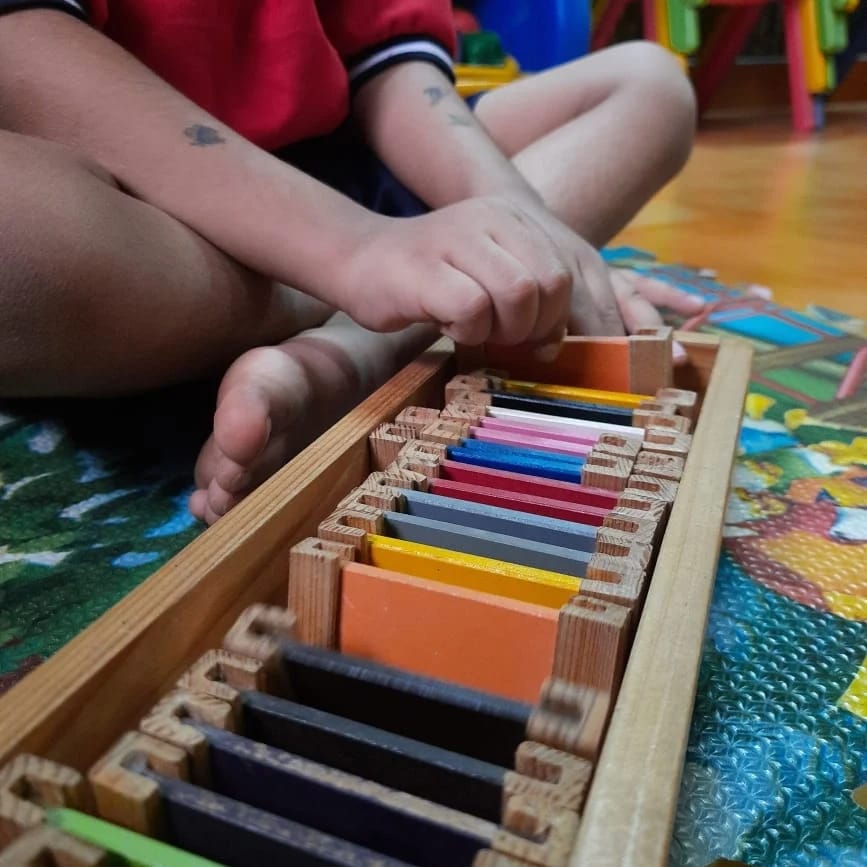
Instead of only using worksheets, teachers can use everyday objects.
For example:
“Can you give me three blocks?”
This turns a maths lesson into an activity.
Hands-on learning can make early maths easier and more enjoyable.
9. Don’t Forget Social and Emotional Development
School is not only about academics.
An LKG child is also learning how to:
- Make friends
- Share
- Take turns
- Listen to others
- Follow simple rules
- Express feelings
- Ask for help
- Work in a group
Ask teachers how they handle situations when children disagree or have difficulty sharing.
The aim should be to help children understand their feelings and learn appropriate ways to interact with others.
10. Look for Plenty of Play
Play is an important part of early childhood.
When children play, they can practise:
- Communication
- Problem-solving
- Coordination
- Imagination
- Cooperation
- Decision-making
Ask whether the school provides opportunities for both indoor and outdoor play.
Children should have time to move around instead of spending the entire school day doing table-based activities.
A balanced day can include learning, play, movement, creativity, meals or snacks, and appropriate rest.
11. Check for Art and Creative Activities
Not every child expresses themselves through words.
Some children communicate through:
- Drawing
- Painting
- Music
- Dance
- Craft
- Pretend play
Creative activities can help children express ideas while developing coordination and imagination.
When visiting a school, ask:
“How often do children participate in art, music, and creative activities?”
A good LKG programme should leave room for creativity alongside early academics.
12. Understand the Daily Routine
Ask the school to explain a typical LKG day.
For example, a balanced routine might include:
Circle time → language activity → numeracy → snack → outdoor play → art activity → story time → group activity
The exact schedule will vary.
What matters is whether the day provides enough variety.
Young children can find long periods of one activity tiring.
A varied routine can help keep them engaged.
13. Ask About Homework
Parents often assume that more homework means better education.
That isn’t necessarily true for young children.
Ask:
- How much homework is given?
- Is it given every day?
- How long should it take?
- Is it age-appropriate?
- Are parents expected to complete activities for their children?
LKG children also need time to play, talk with family, explore, and rest after school.
Homework should not become a daily struggle.
14. Find Out How the School Tracks Progress
Ask how teachers monitor children’s development.
A good school may use:
- Classroom observation
- Activity-based assessment
- Progress reports
- Parent-teacher meetings
- Individual feedback
Early childhood assessment should look at more than test scores.
Teachers can also observe:
- Communication
- Participation
- Social interaction
- Motor skills
- Independence
- Problem-solving
- Understanding of concepts
This gives parents a more complete picture of their child’s development.
15. Check How the School Communicates With Parents
Parents should know what is happening in their child’s school life.
Ask:
“How will I receive updates about my child’s progress?”
Find out whether the school conducts:
- Parent-teacher meetings
- Regular progress updates
- School events
- Parent communication sessions
Good communication allows parents and teachers to work together.
If a child is struggling with something at school, parents should know about it early.
16. Consider the Location
If your family lives in RT Nagar, choosing an LKG school near your home can make the daily routine easier.
A shorter commute can mean:
- Less time spent travelling
- Easier mornings
- Less tiredness
- More time for family
- A simpler pick-up routine
However, location should not be your only deciding factor.
A school being five minutes away does not automatically make it the best choice.
Consider distance together with safety, teaching quality, activities, teachers, and your child’s comfort.
17. Compare the Complete Fee Structure
Fees are naturally important when selecting an LKG school.
But don’t compare only the headline tuition fee.
Ask about:
- Admission fees
- Tuition fees
- Books
- Uniform
- Activity charges
- Transportation
- Meals or snacks
- Other additional costs
School fees can vary considerably depending on the type of school and facilities offered, so understanding the complete fee structure before admission can help parents plan better.
The cheapest option isn’t always the best value, and the most expensive school isn’t automatically the best school.
Look at what your child actually receives for the fees.
18. Ask About School Readiness
One useful question to ask is:
“How does your LKG programme prepare children for the next stage?”
The answer shouldn’t only focus on academics.
School readiness can include:
- Listening to instructions
- Communicating clearly
- Holding a pencil comfortably
- Recognising basic letters and numbers
- Following routines
- Working with other children
- Managing simple tasks independently
- Feeling confident in a classroom
These skills can help children transition smoothly into higher classes.
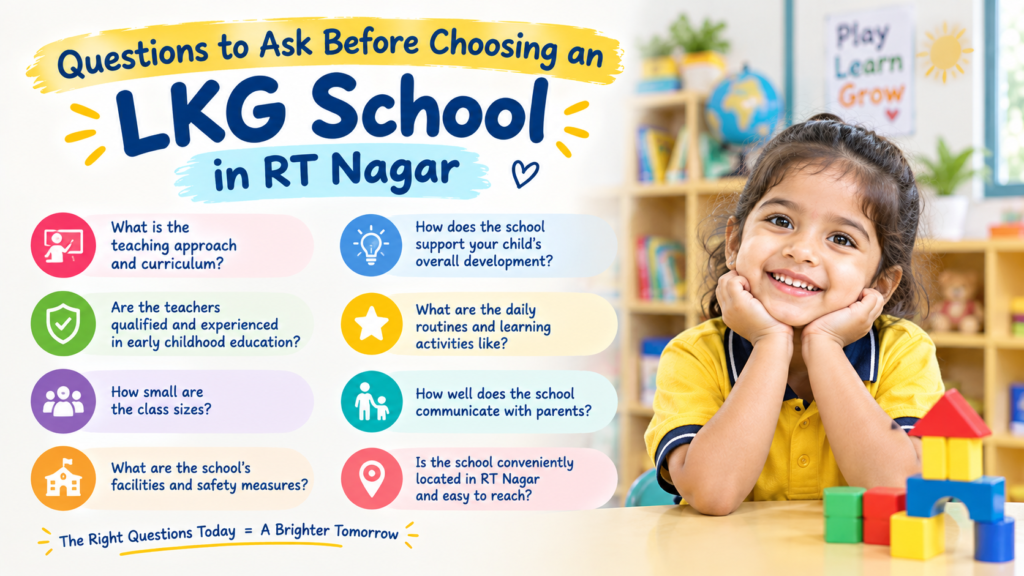
Questions to Ask Before Choosing an LKG School in RT Nagar
Before making your final decision, take a small checklist with you.
Learning Questions
- What learning approach do you follow?
- How do you teach reading and writing?
- How do you introduce maths?
- How much screen-based learning is used?
- How much homework is given?
Teacher Questions
- What is the teacher-child ratio?
- How do teachers handle children who need extra support?
- How are behavioural concerns handled?
- How often do teachers communicate with parents?
Safety Questions
- How are children handed over during pick-up?
- How are visitors managed?
- What happens during an emergency?
- How are outdoor activities supervised?
Routine Questions
- What does a typical LKG day look like?
- How much time is spent outdoors?
- Are art and music included?
- Are children given enough opportunities for free play?
Asking these questions can help you compare schools based on what actually matters.
Red Flags Parents Should Not Ignore
While visiting an LKG school, trust your observations.
Some possible warning signs include:
- Teachers frequently shouting at children
- Children appearing afraid to communicate
- Poor hygiene
- Unsafe play areas
- Unclear pick-up procedures
- Very little outdoor or free play
- Excessive worksheet-based learning
- Staff avoiding basic parent questions
- A classroom that feels overcrowded or poorly supervised
One small issue does not necessarily tell you everything about a school.
However, several concerns together deserve a closer look.
Why Gokul Preschool in RT Nagar Can Be Considered for LKG
For parents searching for an LKG school in RT Nagar, Gokul Preschool offers an LKG programme designed for children around the 4–5 age group, combining early academics with confidence-building, independence, activity-based learning, and creative experiences.
The programme includes experiences such as:
- Circle time
- Interactive discussions
- Activity-based academic learning
- Writing practice
- Storytelling
- Art and craft
- Indoor and outdoor play
- Hygiene routines
- Parent-teacher interactions
- Child-friendly progress tracking
At Gokul Preschool, the focus is not only on what children can memorise.
It is also about helping them become comfortable learners who can communicate, participate, explore, and gradually become more independent.
For parents in RT Nagar, visiting the campus and speaking directly with the teachers is the best way to understand whether the environment matches your child’s needs.
A Simple LKG School Checklist
Before you make your final choice, ask yourself:
☐ Is the school safe?
☐ Are the teachers caring and approachable?
☐ Is the classroom clean and child-friendly?
☐ Is the learning approach suitable for my child’s age?
☐ Does the school include play and movement?
☐ Are reading and writing introduced gradually?
☐ Are maths concepts taught through practical activities?
☐ Are art, music, and creativity included?
☐ Does the school support social and emotional development?
☐ Is the teacher-child ratio comfortable?
☐ Does the school communicate well with parents?
☐ Is the fee structure clear?
☐ Is the location convenient for my family?
☐ Does my child seem comfortable during the visit?
If most of your answers are yes, you may have found a school worth considering.
What to Look for in an LKG School in RT Nagar FAQs
What should I look for in an LKG school in RT Nagar?
Look at the school’s safety, teachers, learning approach, classroom environment, teacher-child ratio, play opportunities, activities, parent communication, fee structure, and overall suitability for your child.
What age is LKG generally for?
LKG is commonly designed for children around 4 to 5 years old, although the exact age criteria can vary between schools. Gokul Preschool’s LKG programme is designed for children aged 4–5.
What should children learn in LKG?
Children can develop early literacy, numeracy, communication, fine motor skills, social skills, independence, creativity, and classroom habits through age-appropriate activities.
Is play important in LKG?
Yes. Play provides children with opportunities to develop communication, coordination, creativity, problem-solving, and social skills while enjoying the learning process.
How important is the teacher-child ratio?
A manageable teacher-child ratio can make it easier for teachers to notice individual children’s needs and provide appropriate support.
Should I choose an LKG school close to home?
A nearby school can make daily travel easier and reduce commute time. However, parents should consider distance alongside safety, teaching quality, activities, teachers, and the child’s comfort.
How can I check if an LKG school is safe?
Visit the school and ask about entry and exit procedures, visitor management, child pick-up, staff supervision, emergency procedures, first aid, fire safety, and playground safety.
How much homework should an LKG child receive?
Homework should be age-appropriate and manageable. Young children also need plenty of time for play, family interaction, rest, and exploration outside school.
How do I know if my child is comfortable with an LKG school?
Visit the school with your child and observe their reaction. Look at whether they appear comfortable around teachers, interested in the classroom, and willing to explore the environment.
Is Gokul Preschool an LKG school in RT Nagar?
Yes. Gokul Preschool in RT Nagar offers an LKG programme for children aged 4–5, with a focus on early academics, activity-based learning, creativity, confidence, and independence.
Conclusion
Choosing an LKG school in RT Nagar is about finding the right environment for your child’s early learning years.
Don’t choose a school simply because it has a popular name, a beautiful building, or attractive advertisements.
Visit the school.
Observe the classroom.
Talk to the teachers.
Ask about safety.
Understand the daily routine.
Find out how children learn.
Most importantly, watch how the school makes your child feel.
A good LKG experience should help children become more confident, curious, independent, and comfortable with learning.
At Gokul Preschool in RT Nagar, we believe that children learn best when education combines structure with play, encouragement with independence, and learning with joyful experiences.
The right LKG school is not necessarily the one that promises the most.
It is the one that understands your child and gives them a safe, supportive place to learn and grow.