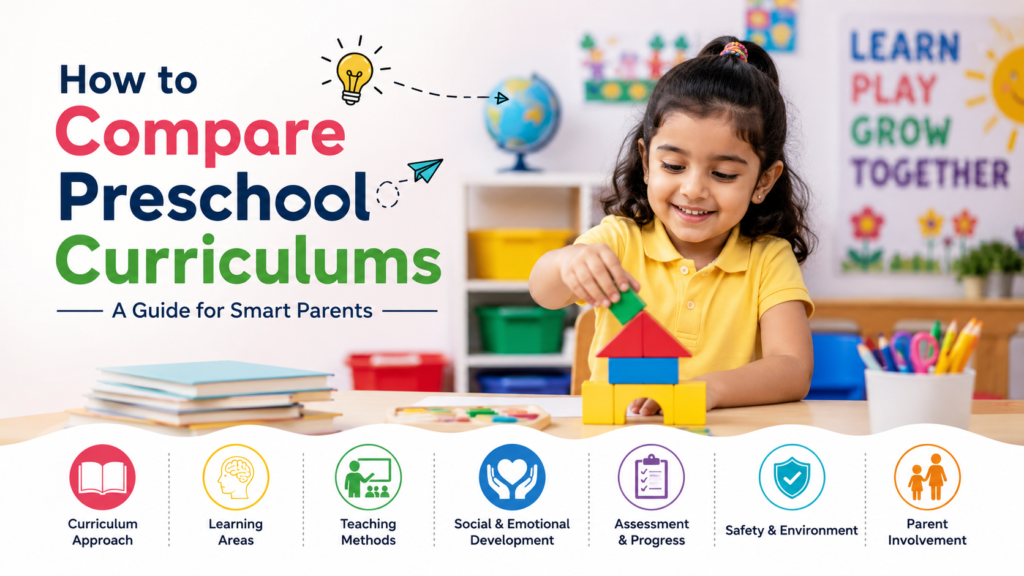
How to Compare Preschool Curriculums
Choosing a preschool isn’t just about finding a school that’s close to home or has colorful classrooms. One of the most important factors to consider is the preschool curriculum. But when you start researching, you may come across terms like Montessori, play-based learning, EYFS, activity-based learning, and theme-based curriculum. It can quickly become confusing.
So, how do you compare preschool curriculums and know which one is right for your child?
The good news is that you don’t need to be an education expert. Instead of focusing on fancy names, look at how the curriculum helps children learn, play, and grow. The best preschool curriculum is one that supports your child’s overall development while making learning enjoyable.
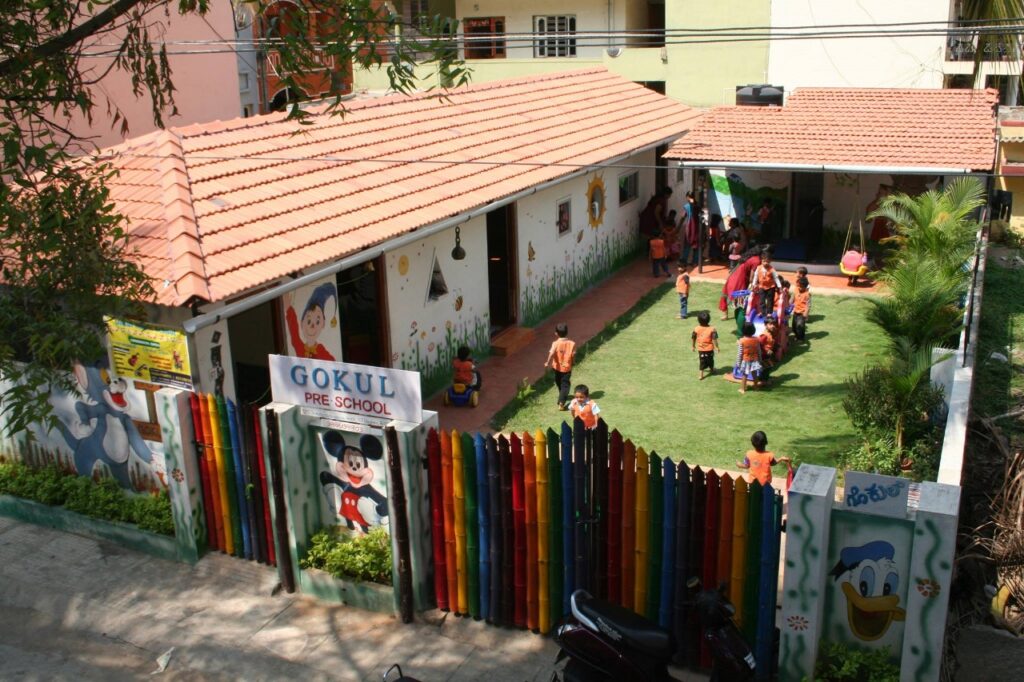
At Gokul Preschool in RT Nagar, we follow a child-centered, play-based approach that encourages curiosity, creativity, confidence, and independence. Our goal is to help children build a strong foundation for lifelong learning.
In this blog, we’ll explain how to compare preschool curriculums and what parents should look for before making a decision.
- What Is a Preschool Curriculum?
- Why the Curriculum Matters
- Don't Be Confused by the Name of the Curriculum
- Look for a Play-Based Learning Approach
- Check Whether the Curriculum Supports Overall Development
- Ask How Children Learn
- Check if Learning Is Age-Appropriate
- Observe the Classroom During a Visit
- Ask About Daily Activities
- Understand How Progress Is Measured
- Ask About Teacher Involvement
- Look for Parent Communication
- Avoid Choosing Based Only on Academics
- Questions to Ask When Comparing Preschool Curriculums
- Common Mistakes Parents Make
- Why Parents Choose Gokul Preschool in RT Nagar
- How to Compare Preschool Curriculums FAQs
- Conclusion
What Is a Preschool Curriculum?
A preschool curriculum is the plan that guides what and how children learn during their early years.
It includes activities that help children develop:
- Language and communication skills
- Early literacy and numeracy
- Social and emotional skills
- Physical development
- Creativity
- Problem-solving abilities
- Independence
A good curriculum doesn’t focus only on academics. It supports the overall growth of the child.
Why the Curriculum Matters
The preschool years are when children develop important habits and skills that shape future learning.
A well-designed curriculum helps children:
- Enjoy learning
- Build confidence
- Improve communication
- Develop curiosity
- Learn through exploration
- Strengthen social skills
Instead of memorizing information, children should be encouraged to ask questions, solve problems, and discover new ideas.
Don’t Be Confused by the Name of the Curriculum
Many preschools promote different teaching methods.
You may hear terms such as:
- Montessori
- Play-Based Learning
- Activity-Based Learning
- Theme-Based Learning
- EYFS (Early Years Foundation Stage)
- Reggio Emilia-inspired approaches
While each has unique features, what matters most is how the curriculum is implemented.
A curriculum is only effective when experienced teachers deliver it in a nurturing and engaging environment.
Look for a Play-Based Learning Approach
Young children learn best through play.
Play-based learning helps children develop:
- Creativity
- Communication
- Social skills
- Critical thinking
- Problem-solving
- Confidence
Activities such as storytelling, pretend play, puzzles, music, and outdoor games teach valuable skills while keeping children interested and happy.
A preschool that balances structured learning with free play often provides the best learning experience.
Check Whether the Curriculum Supports Overall Development
A quality preschool curriculum should focus on every aspect of a child’s growth.
Cognitive Development
Children learn to:
- Recognize patterns
- Solve simple problems
- Think creatively
- Explore new ideas
Language Development
Children improve through:
- Storytelling
- Conversations
- Rhymes
- Vocabulary-building activities
Social Development
Children learn how to:
- Share
- Cooperate
- Make friends
- Work in groups
Emotional Development
A good curriculum helps children:
- Express emotions
- Build confidence
- Develop resilience
- Handle small challenges
Physical Development
Children strengthen:
- Fine motor skills
- Gross motor skills
- Hand-eye coordination
- Balance
Choose a curriculum that develops the whole child—not just academic skills.
Ask How Children Learn
Instead of asking “What do children learn?”, ask:
“How do children learn?”
Look for classrooms where children are:
- Asking questions
- Exploring learning materials
- Participating in activities
- Working together
- Creating art
- Playing with purpose
Active participation leads to deeper learning than passive instruction.
Check if Learning Is Age-Appropriate
Young children should never feel pressured.
A preschool curriculum should match the child’s stage of development.
Children should have opportunities to:
- Explore
- Experiment
- Make mistakes
- Learn through experience
Avoid programs that place too much emphasis on worksheets or formal academics at an early age.
Observe the Classroom During a Visit
One of the best ways to evaluate a curriculum is to see it in action.
During your visit, ask yourself:
- Are children actively engaged?
- Are they smiling and participating?
- Are teachers encouraging exploration?
- Is learning happening through activities?
A lively classroom often reflects an effective curriculum.
Ask About Daily Activities
A balanced curriculum includes a variety of experiences.
Look for activities such as:
- Storytelling
- Circle time
- Music and movement
- Art and craft
- Sensory play
- Outdoor play
- Free play
- Early literacy and numeracy activities
Children benefit from a mix of structured and unstructured learning.
Understand How Progress Is Measured
Preschool should not feel like an examination.
Ask how teachers track children’s development.
Good preschools observe:
- Communication skills
- Social interactions
- Confidence
- Independence
- Participation
- Learning progress
Regular observations help teachers support each child’s individual needs.
Ask About Teacher Involvement
Even the best curriculum depends on the teachers implementing it.
Find out:
- Are teachers trained in early childhood education?
- Do they adapt activities for different learning styles?
- How do they support shy or struggling children?
Warm, caring teachers make any curriculum more effective.
Look for Parent Communication
Parents should understand what their child is learning.
Ask whether the preschool provides:
- Regular updates
- Progress discussions
- Parent-teacher meetings
- Classroom activity reports
Strong communication creates consistency between home and school.
Avoid Choosing Based Only on Academics
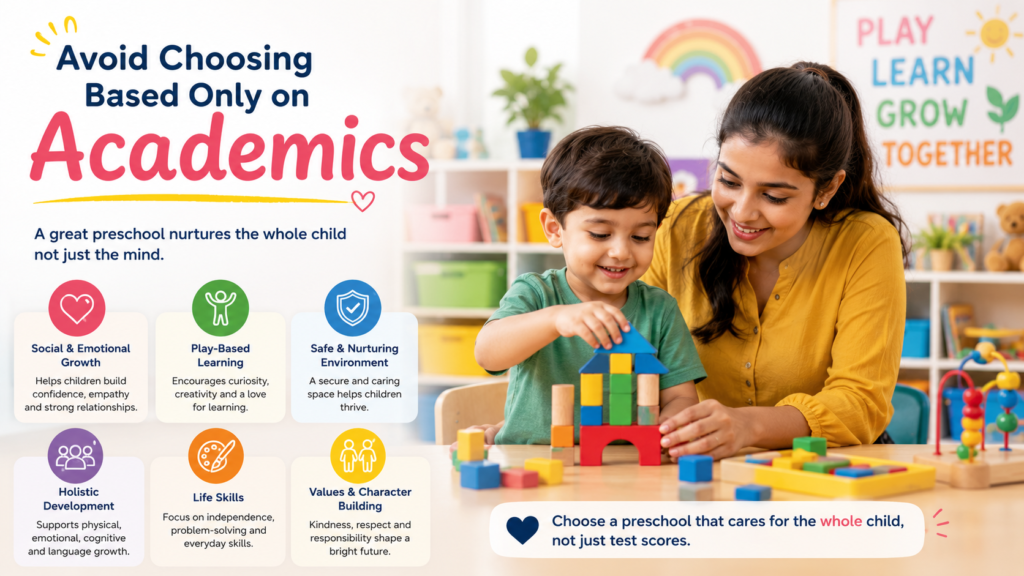
Many parents assume that a preschool teaching reading and writing earlier is automatically better.
However, research consistently shows that young children learn best through meaningful play, conversation, exploration, and hands-on experiences.
A balanced curriculum prepares children not only for primary school but also for life.
Questions to Ask When Comparing Preschool Curriculums
Before making your decision, ask each preschool:
What teaching approach do you follow?
Understand the philosophy behind the curriculum.
How do children learn during the day?
Request a sample daily schedule.
How much time is spent on play?
Play is essential for early childhood development.
How do you encourage creativity?
Ask about art, music, storytelling, and imaginative play.
How do you support children who learn differently?
Every child develops at a unique pace.
Common Mistakes Parents Make
Choosing Based on Fancy Curriculum Names
A well-implemented play-based curriculum often provides better outcomes than a famous curriculum that isn’t delivered effectively.
Expecting Formal Academics Too Early
Preschool should develop curiosity and confidence—not create unnecessary academic pressure.
Ignoring the Classroom Environment
Observe whether children are actively engaged and enjoying learning.
Forgetting to Meet the Teachers
Teachers bring the curriculum to life.
Their warmth, patience, and experience matter just as much as the curriculum itself.
Why Parents Choose Gokul Preschool in RT Nagar
At Gokul Preschool in RT Nagar, we believe children learn best when they feel happy, safe, and inspired to explore.
Our curriculum focuses on:
- Play-based learning
- Activity-based experiences
- Language and communication development
- Early literacy and numeracy
- Social and emotional growth
- Creativity and critical thinking
- Physical development through indoor and outdoor activities
Our experienced teachers create engaging learning experiences that encourage curiosity, independence, and confidence.
Families looking for a trusted preschool in RT Nagar choose Gokul Preschool because our curriculum is designed around children’s developmental needs rather than unnecessary academic pressure.
How to Compare Preschool Curriculums FAQs
What is the best preschool curriculum?
There is no single “best” curriculum. The right curriculum is one that supports your child’s overall development through play, exploration, and age-appropriate learning.
Is play-based learning better than traditional teaching?
For preschool-aged children, play-based learning is highly effective because it develops cognitive, social, emotional, and physical skills while keeping children engaged.
Should preschool focus on academics?
Preschool should introduce early literacy and numeracy while giving equal importance to creativity, communication, social skills, and emotional development.
How can I compare two preschool curriculums?
Compare their teaching approach, daily activities, teacher involvement, learning environment, child engagement, and how they support overall development.
Which preschool in RT Nagar offers a balanced curriculum?
Gokul Preschool in RT Nagar provides a play-based, child-centered curriculum that supports children’s social, emotional, physical, and academic growth in a safe and nurturing environment.
Conclusion
Comparing preschool curriculums doesn’t have to be complicated.
Instead of focusing only on curriculum names, pay attention to how children learn every day.
The best curriculum is one that:
- Encourages learning through play
- Supports overall development
- Builds confidence and independence
- Matches your child’s developmental stage
- Is delivered by caring and qualified teachers
When children enjoy learning, they naturally develop the skills they need for future success.
At Gokul Preschool in RT Nagar, our child-centered curriculum helps children discover, explore, and grow in a safe, nurturing, and engaging environment.