Best Age to Start Nursery School in Bengaluru
One of the most common questions parents ask before preschool admission is, “What is the best age to start nursery school?”
If you are a parent in Bengaluru, you may have noticed that different schools have different admission rules. Some schools offer playgroup or pre-nursery for younger children, while Nursery is commonly meant for children around 3 to 4 years old.
But age is not the only thing parents should consider.
A child may be three years old but still need more time to become comfortable away from parents. Another child may be ready to enjoy a structured nursery environment soon after turning three.
So, the better question is not only “How old is my child?” but also “Is my child ready for nursery?”
For many children, around 3 years of age is a common starting point for Nursery. However, parents should always check the individual preschool’s age criteria and cut-off date before applying. Current Bengaluru-area guidance shows that many schools use age-based eligibility around the 3+ range, while exact cut-off dates can differ, Gokul Preschool.
What Is the Typical Age for Nursery in Bengaluru?
In many preschool and school systems, Nursery is generally for children who are around 3 to 4 years old.
A common progression looks like this:
- Playgroup / Pre-Nursery: Around 2–3 years
- Nursery: Around 3–4 years
- LKG: Around 4–5 years
- UKG: Around 5–6 years
However, this is only a general guide.
Some schools may use different names for their programs or follow different admission cut-off dates. For example, a Bengaluru school may ask that a child completes the required age by June 1, while another school may use a March 31 cut-off.
Therefore, parents should never choose a class based only on a child’s current age. Always ask the preschool for its latest admission criteria.
Is 3 Years a Good Age to Start Nursery?
For many children, yes.
Around age three, children are often becoming more independent and interested in exploring their surroundings. They may start communicating more clearly, following simple instructions and enjoying interaction with other children.
A good Nursery program can give children opportunities to:
- Make friends
- Listen to stories
- Sing songs and rhymes
- Explore colours and shapes
- Practise early counting
- Improve vocabulary
- Participate in creative activities
- Develop fine-motor skills
- Follow simple routines
- Become more independent
The purpose of Nursery should not be to rush children into formal academics.
Instead, it should help them build a strong foundation for future learning.
Why Age Alone Does Not Decide School Readiness
Two children of exactly the same age can have very different personalities and levels of independence.
One child may happily walk into a classroom and start playing.
Another may feel nervous, stay close to a parent and need more time to adjust.
Both can be completely normal.
That is why parents should look at developmental readiness along with age.
Ask yourself:
- Can my child communicate basic needs?
- Can my child follow simple instructions?
- Can my child stay with another trusted adult for a short time?
- Is my child interested in playing with other children?
- Can my child manage some simple tasks independently?
- Can my child sit for a short activity?
- Is my child curious about new surroundings?
Your child does not need to be perfect in all these areas.
Nursery itself is a place where children develop these skills.
Signs Your Child May Be Ready for Nursery
1. Your Child Shows Curiosity
Does your child ask questions?
Do they want to know the names of objects, animals, colours or people?
Curiosity is a wonderful foundation for early learning.
A good Nursery environment can give children opportunities to explore that curiosity through stories, games, activities and conversations.
2. Your Child Can Communicate Basic Needs
Your child does not need to speak perfectly.
But being able to communicate simple needs such as:
- “I want water.”
- “I need help.”
- “I want to go to the toilet.”
- “I am hungry.”
- “I don’t like this.”
can make the transition to Nursery easier.
3. Your Child Can Follow Simple Instructions
Nursery children gradually learn to follow simple classroom instructions.
For example:
- Sit in the circle.
- Put the toys away.
- Wash your hands.
- Stand in a line.
- Take your book.
- Wait for your turn.
Being able to understand simple instructions can help children feel more comfortable in a classroom.
4. Your Child Is Becoming More Independent
Your child does not need to do everything alone.
However, small signs of independence can be helpful.
For example, your child may be learning to:
- Eat with limited help
- Drink water independently
- Put toys away
- Wear or remove simple footwear
- Wash hands
- Tell an adult when they need help
Nursery can gradually strengthen these skills.
5. Your Child Is Interested in Other Children
If your child watches other children, tries to play alongside them or enjoys interacting with them, this can be a positive sign.
Social development is an important part of Nursery.
Children learn to share, take turns, listen and cooperate through everyday experiences.
What If My Child Is Not Ready at Age 3?
There is no need to panic.
Being three years old does not mean that every child will adjust to Nursery in exactly the same way.
Some children may need extra time with:
- Separation from parents
- Communication
- Toilet routines
- New environments
- Social interaction
- Following classroom routines
Parents can gently support these skills at home.
You can start by introducing short periods away from parents, encouraging simple self-help activities and creating predictable daily routines.
The goal should be gradual readiness rather than pressure.
What Happens in a Good Nursery Classroom?
Parents sometimes imagine Nursery as a classroom where children sit at desks and complete worksheets.
That does not have to be the case.
Young children can learn through a mixture of:
Storytelling
Stories introduce new words, characters, ideas and emotions.
Music and Rhymes
Songs and rhymes can encourage language, memory, rhythm and participation.
Art and Craft
Drawing, colouring, painting and simple craft activities can support creativity and fine-motor development.
Hands-On Activities
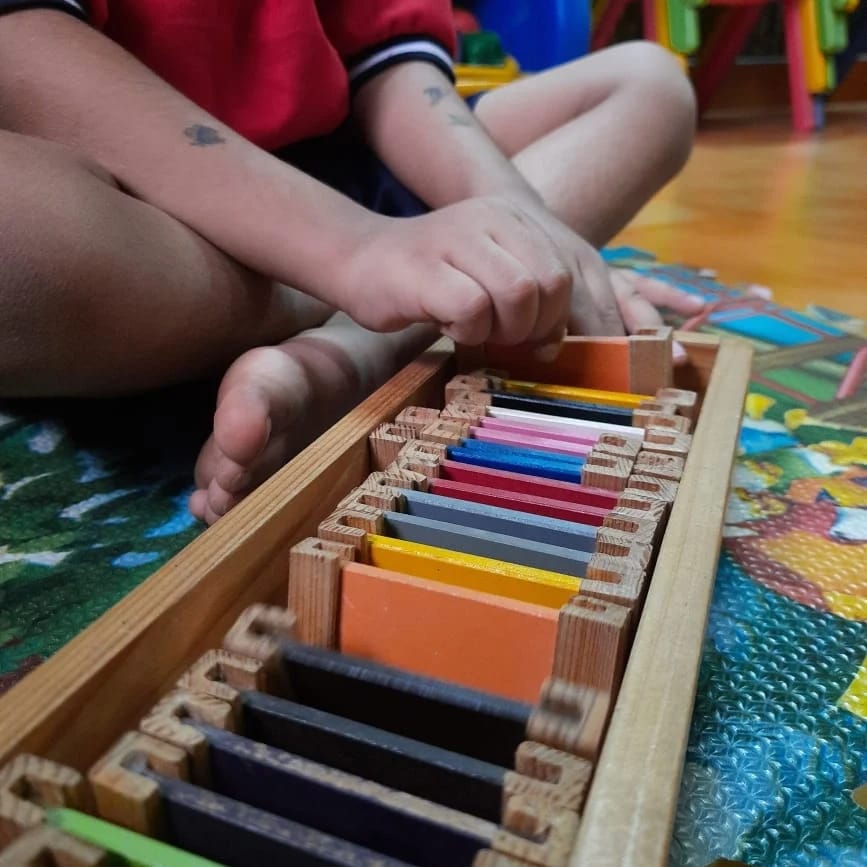
Sorting objects, building blocks, matching games and simple puzzles allow children to learn by doing.
Outdoor Play
Running, jumping, climbing and movement activities support physical development.
Circle Time
Children can practise listening, speaking and participating in a group.
A balanced Nursery environment should give children opportunities to learn while still allowing them to be children.
What Should Parents Look for in a Nursery in Bengaluru?
Once you know your child may be ready, the next step is choosing the right school.
Don’t select a Nursery only because it is close to your home or has attractive photographs online.
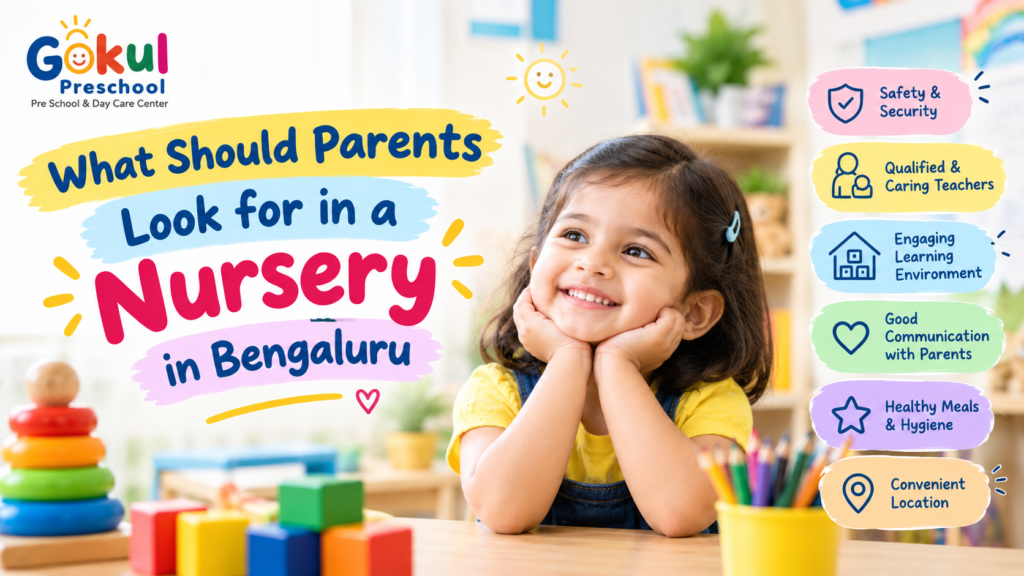
Visit the preschool and check:
Safety
Ask about entry and exit procedures, child supervision, emergency arrangements and authorised pickup.
Teachers
Observe whether teachers speak patiently and respectfully to children.
Classroom Environment
Look for clean, welcoming spaces with age-appropriate materials.
Learning Approach
Ask whether children learn through play, activities, stories and hands-on experiences.
Daily Routine
Understand what your child will do from arrival until pickup.
Hygiene
Check classrooms, washrooms, drinking water and play areas.
Parent Communication
Ask how teachers share updates about your child’s development.
Fees
Understand the complete fee structure and any additional charges.
How Parents Can Prepare a Child for Nursery
Starting Nursery can be easier when children have already practised some simple routines at home.
Create a Simple Daily Routine
Try to keep regular times for:
- Waking up
- Meals
- Play
- Bathing
- Sleep
A predictable routine can help children feel secure.
Practise Short Separations
Leave your child with a trusted family member for short periods.
This can gradually teach them that parents leave and return.
Encourage Independent Eating
Give your child opportunities to eat independently, while providing help when necessary.
Teach Simple Self-Help Skills
Practise washing hands, putting toys away and asking for help.
Talk Positively About School
Instead of saying:
“Don’t cry when I leave you.”
try talking about the fun things your child may experience:
“You can play with blocks, listen to stories and meet your teacher.”
Keep the conversation positive and relaxed.
Should You Start Nursery Immediately After Your Child Turns 3?
Not necessarily.
A child’s birthday does not automatically mean they must start school the next day.
Admission depends on:
- The school’s age criteria
- Cut-off date
- Academic session
- Child’s readiness
- Family circumstances
- Availability of the appropriate program
Some Bengaluru schools specify an exact date by which the child must reach the required age. For example, current 2026–27 guidance from one school specifies 3+ years for Nursery based on a March 31 age cut-off.
This is why parents should contact the individual preschool before making plans.
What If My Child Turns 3 After the Cut-Off Date?
This is a common concern for parents.
Suppose your child turns three shortly after the school’s stated cut-off date.
Do not assume that admission is impossible.
Ask the preschool:
- What is the exact cut-off date?
- Is there any age relaxation?
- Can my child join another age-appropriate program?
- What will be the progression to LKG?
- Will the school consider the child’s overall readiness?
Policies differ between schools, so the preschool’s current admission rules should be treated as the final reference.
Is Starting Nursery Too Early a Problem?
Starting early is not automatically a problem, but the quality and suitability of the program matter.
If a very young child is placed in an environment that expects long periods of sitting, heavy writing or advanced academic work, the experience may become stressful.
For young children, early education should be age-appropriate.
A good Nursery program should give children plenty of opportunities to:
- Play
- Talk
- Move
- Explore
- Create
- Socialise
- Ask questions
- Build confidence
Is Starting Nursery at 3.5 Years Too Late?
No.
Parents sometimes worry that their child will fall behind if they do not start immediately at age three.
There is no reason to compare your child’s journey with another child’s.
Some children start earlier, while others start later depending on school cut-offs, readiness and family circumstances.
What matters is whether the chosen program is suitable for your child’s age and developmental needs.
Nursery at Gokul Preschool in RT Nagar
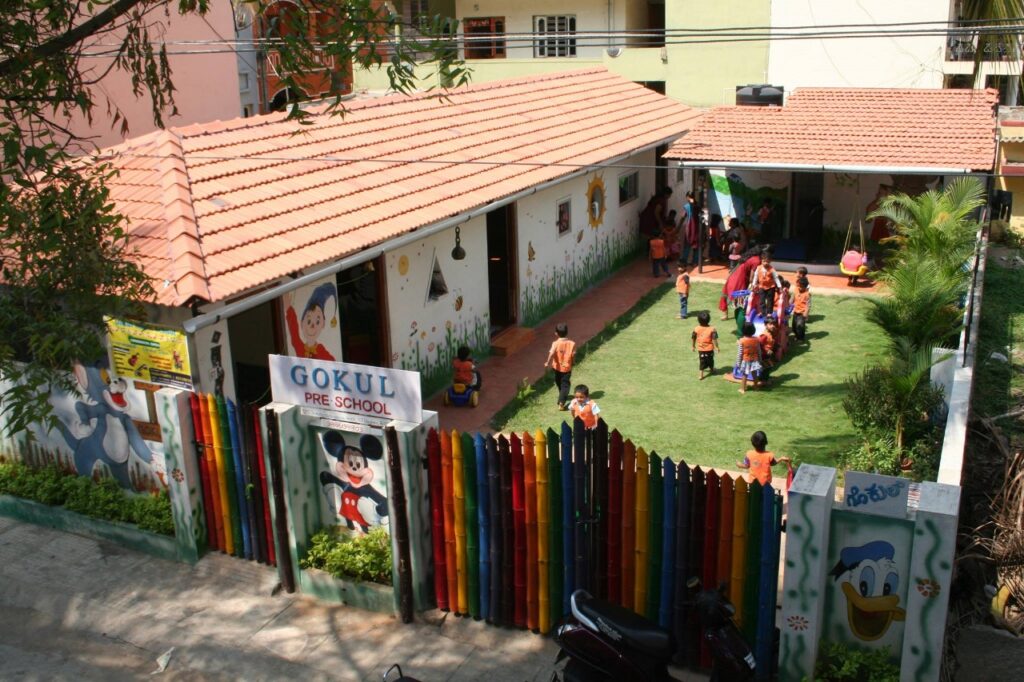
For parents looking for a Nursery program in RT Nagar, Bengaluru, Gokul Preschool provides a child-friendly early learning environment.
Gokul Preschool’s Nursery program is designed for children in the 3–4 age group, with learning experiences that include early language, numeracy, creativity, social development, play and hands-on activities.
The aim is to help children gradually become comfortable with school routines while developing confidence and independence.
Parents can also visit the preschool to understand the classroom environment and speak with educators before making an admission decision.
Gokul Preschool is located in RT Nagar, Bengaluru, making it a convenient option for families living in and around the area.
For current Nursery admission details, parents should contact the preschool directly and confirm the latest age criteria, availability and admission dates.
A Simple Nursery Readiness Checklist
Before starting Nursery, parents can use this quick checklist:
☐ My child is within the school’s required age range
☐ I have checked the school’s age cut-off date
☐ My child can communicate basic needs
☐ My child can follow simple instructions
☐ My child is beginning to become independent
☐ My child can spend a short time away from parents
☐ My child shows curiosity about new things
☐ My child can participate in simple activities
☐ I have visited the preschool
☐ I have spoken with the teachers
☐ I understand the daily routine
☐ I have checked the safety arrangements
☐ I understand the complete fee structure
☐ I know which documents are required
☐ I understand how the school supports children during adjustment
You do not need to tick every box perfectly.
The checklist is simply a way to think about your child’s current needs.
Best Age to Start Nursery School in Bengaluru FAQs
What is the best age to start Nursery in Bengaluru?
Around 3 years is a common age for Nursery admission, with children typically moving through Nursery around ages 3–4. However, each preschool can have its own age cut-off and admission rules.
Is 3 years too early for Nursery?
Not necessarily. Many children are ready for a Nursery environment around age three, especially when the program is play-based, caring and age-appropriate. Parents should consider both age and individual readiness.
Can a 3-year-old start Nursery without attending playgroup?
Yes, it can be possible. A child does not necessarily need to attend playgroup first. However, parents should discuss the child’s age, independence and readiness with the preschool.
What if my child is 3 but is not ready for school?
Give your child time and work on simple routines and independence at home. You can also speak with the preschool about how they support children who need more time to settle.
What should a 3-year-old know before starting Nursery?
A child does not need to know the alphabet, numbers or writing perfectly before Nursery. Being able to communicate basic needs, follow simple instructions and participate in everyday routines is more useful.
What age is LKG after Nursery?
In a common progression, children move from Nursery around ages 3–4 to LKG around ages 4–5. Exact admission rules and cut-off dates depend on the school.
Should parents choose a Nursery close to home?
For many Bengaluru families, a convenient location can make daily travel easier. Consider traffic, travel time, pickup arrangements and your family’s routine before choosing a preschool.
How can I prepare my child for Nursery?
Build simple routines at home, practise basic self-help skills, encourage communication, introduce short separations and talk positively about school.
Final Thoughts
So, what is the best age to start Nursery school in Gokul Preschool, Bengaluru?
For many children, around 3 years of age is a common starting point. But there is no single number that works perfectly for every child.
The school’s age criteria and cut-off date matter. Your child’s readiness matters too.
Instead of asking only, “Is my child old enough?”, ask:
“Is my child ready for this type of learning environment?”
Visit the preschool. Meet the teachers. Observe the classrooms. Ask about the curriculum, safety and daily routine.
And remember that Nursery is not about making children grow up quickly.
It is about giving them a safe and happy place to play, explore, communicate, make friends and discover the joy of learning.